The regulation and what it brings
By Dec 24, 2026, the eIDAS 2.0 regulation requires every EU country to offer its citizens the EU Digital Identity (EUDI) Wallet. This smartphone app serves as a means of digital identification, making it an ideal solution for verifying customer identities during KYC onboarding.
From July 10, 2027, onwards, the EU’s new Anti-Money Laundering Regulation (AMLR) takes effect across all EU countries. Among other legal changes, the AMLR will allow financial institutions to confirm a customer’s identity using an official electronic ID instead of physical documents.
Starting with Dec 24, 2027, eIDAS 2.0 goes a step further: once a customer chooses to use the wallet to prove their identity online, banks will be required to accept it.
Where the wallet fits into customer onboarding
Today, remote onboarding usually runs through an identity & verification (Id&V) provider (KYC/KYB provider). The customer takes a photo of an ID document, records a video and types in their details. Sometimes, it may even require manual review of customer details.
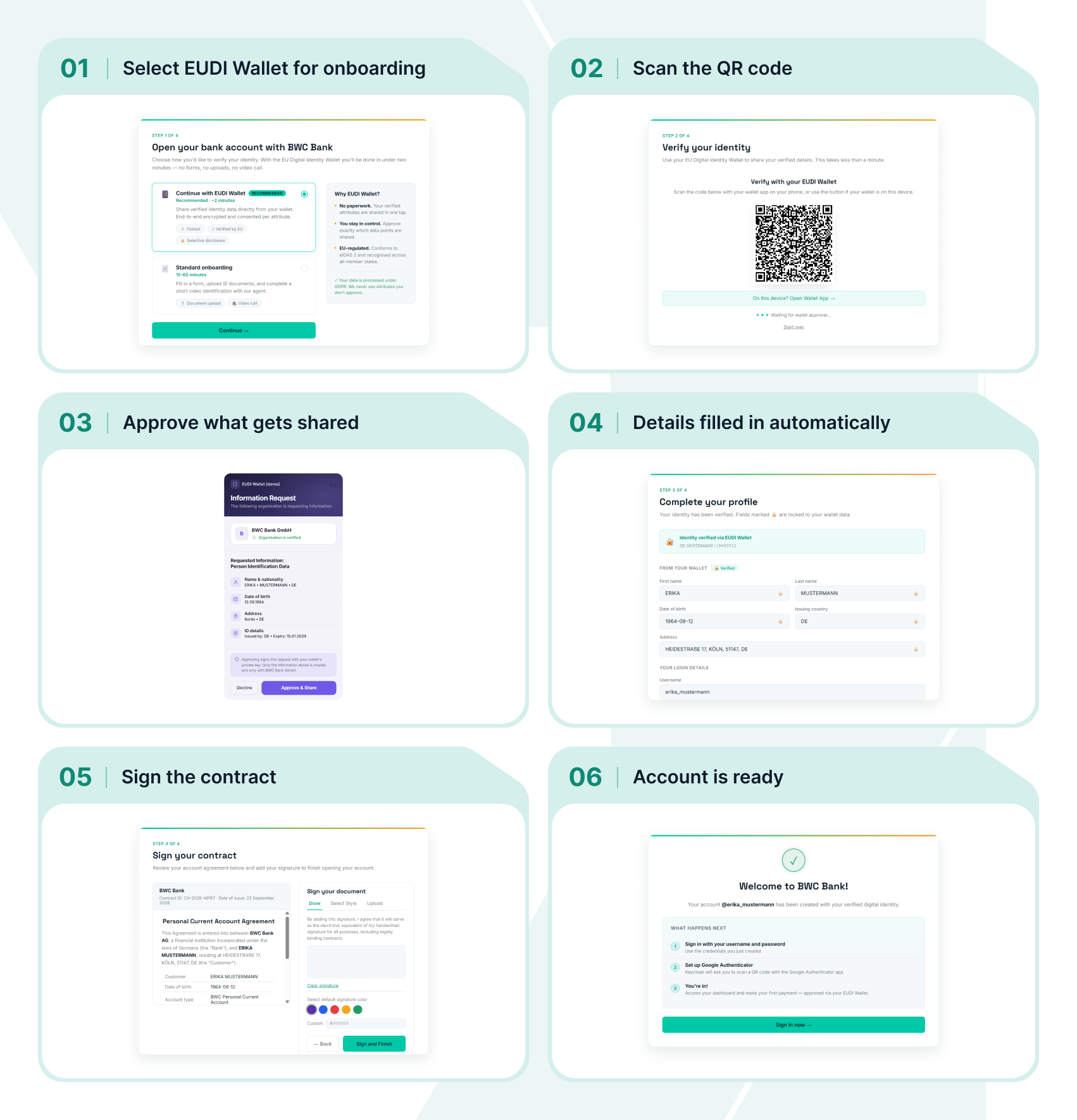
With a digital identity wallet available in each member state, the customer has the chance to register their details with the wallet. If the customer chooses the EUDI-Wallet as a means of onboarding, the bank can request the details they need for this purpose. Subject to the customer’s consent, the data from the identity wallet is shared in a cryptographically secured manner with the bank.
That means less friction for the customer, involving no manual uploads or video identification, lower costs, and a shorter onboarding time for the banks.
The integration challenge for the onboarding use-case
Every EU member state will have at least one EUDI-Wallet in operation by Dec 2026, with more to launch in the next 1-2 years.
These wallets are issued separately, under their own country’s rules, and some details can differ from one country to another. This raises a problem for banks: a customer with a wallet from one country may choose to onboard with a bank in another country and the target bank should be ready to accept it.
The real technical challenge is about the PSPs’ ability to integrate with all EUDI-Wallets across many jurisdictions. Issues related to interoperability, data mapping, local conformance, and integration testing when the wallets are undergoing frequent changes in the early months need to be addressed by an aggregation layer.
Solution approach:
- PSPs should first approach their existing identity & verification (Id&V) / KYC-KYB providers such as Entrust, Jumio, WebID, Sumsub, and explore the support for EUDI-Wallets.
- Buy from the market: Vendors like Banfico can act as an intermediary/technical service provider (TSP) that will be able to support the aggregation of all EUDI-Wallets. The solution will fully comply with the technical standards and come certified. These providers fully follow the market updates and make sure the solution is continuously conforming to the standards & fully tested with all wallet providers.
- Build the solution in-house: As a relying party, the PSPs can build an integration layer that connects to all EUDI-Wallets. This is the least recommended approach due to technical complexity, delivery risks and cost overheads.
In all approaches, the banks must register in their own country as a relying party, which allows them to request data from EUDI-Wallets.
Finally, PSPs should also continue to support for their existing customer onboarding routes as EUDI-Wallets are not forced on the EU citizens.
An illustrative customer experience guideline