

Upcoming regulatory changes will be covered in the openFinance v2 standard, and not anymore in the deprecated versions of NextGenPSD2 v1.3.x. Furthermore, new schemes like giroAPI and EPC SPAA are coming and they will rely on Berlin Group’s openFinance v2 specifications.
Given the context, Banfico wanted to learn more about the adoption rate of openFinance v2, so, over the last couple of months, we ran a survey among three categories of participants, and the learnings are interesting. Read on to find out more.
About the participants
This survey brought together perspectives from across the Open Finance ecosystem, capturing input from ASPSPs (account-servicing institutions, like banks and electronic money institutions), licensed TPPs (third-party providers), and TSPs (technical service providers) – in total 20 participants. While this may not be representative for the whole of the community, the results show an indication of where openFinance v2 standards adoption is heading.
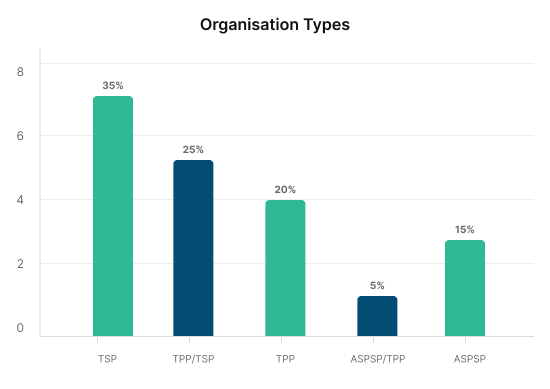
Looking at who responded, TSPs make up the largest share at 35%, suggesting they are among the most engaged stakeholders in this transition. TPPs and dual TPP/TSP organizations together account for 45% of respondents, showing strong representation from the demand side of Open Finance (the organizations building on top of these APIs).
ASPSPs, by contrast, represent a smaller portion of the sample at 15% (plus another 5% operating in a dual ASPSP/TPP capacity), which may reflect either lower direct participation from banks or simply a more proactive voice from TPPs and TSPs in surveys like this one.
The main reasons for upgrading to openFinance v2
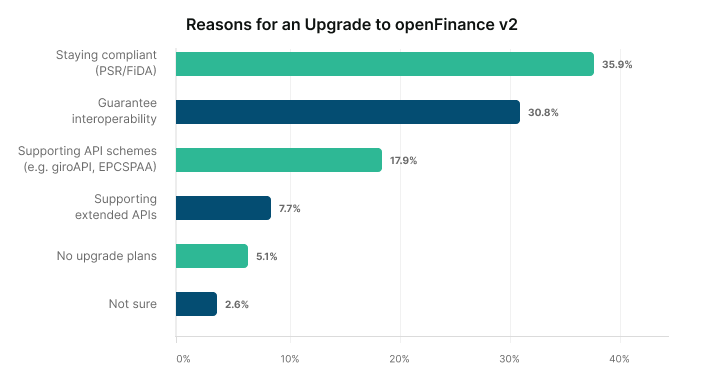
When asked why they are upgrading, respondents pointed overwhelmingly to regulatory pressure. Staying compliant with upcoming PSR/FiDA regulation is the top reason at 35.9%, closely followed by the need to guarantee interoperability at 30.8%.
Support for API schemes like giroAPI and EPC SPAA came in at 17.9%, while support for extended APIs trailed at 7.7%. These numbers paint a clearer picture of the reasons behind openFinance v2 adoption: sImple AIS and PIS are not enough, as the market wants to create new use cases and solutions on the demand side, and to monetise investments on the API infrastructure on the supply side. In other words, the adoption of openFinance v2.
Encouragingly, only a small minority (7.7%, combined between “no upgrade plans” and “not sure”) remained disengaged from the transition, pointing to broad awareness and intent to move forward across the market.
Overall implementation status
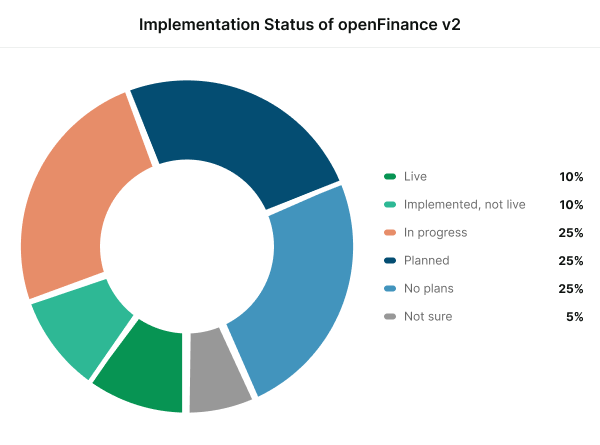
Despite that intent, actual progress remains at an early-to-mid stage. Only 10% of organisations report being fully “Live” with openFinance version 2, and just 20% are either live or implemented but not yet live. Half of all respondents (50%) are actively working toward v2, split evenly between “In progress” and “Planned “, which points to a significant wave of implementations still to come.
That said, 25% report having no plans at all, and a further 5% are unsure, meaning roughly 30% of the ecosystem currently has no clear commitment.
Implementation status by organisation type
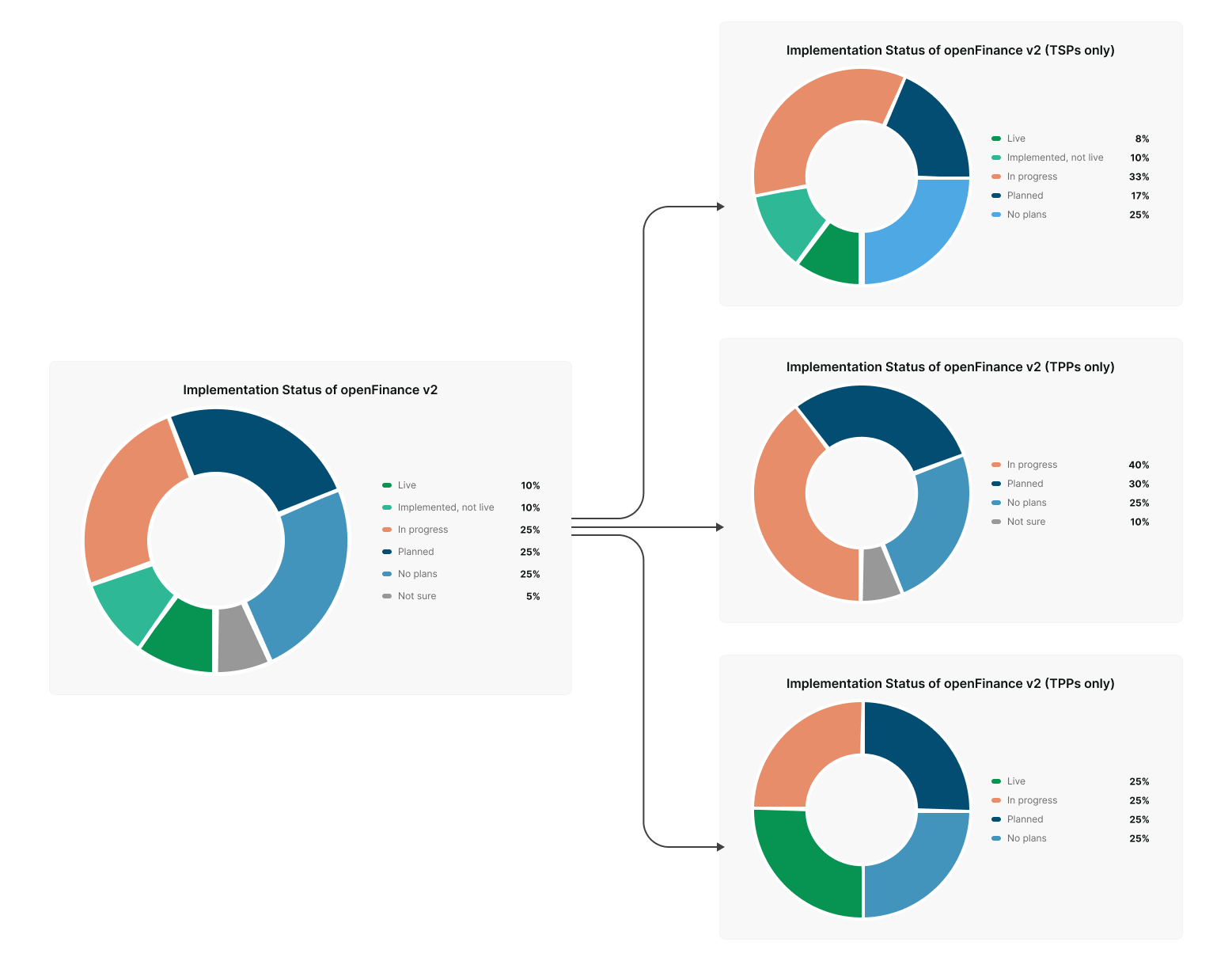
Breaking implementation status down by organization type reveals a clearer story about where the friction lies. TSPs are moving fastest, with 33% “In Progress” and a combined 25% already “Live” or “Implemented “, leaving only 25% with no plans.
TPPs tell a different story: 40% are “In Progress “, but none reports being “Live” or “Implemented” yet, and 30% remain only “Planned “, suggesting TPPs are holding back until they see stronger signals before committing resources. ASPSPs, meanwhile, are evenly split across every stage (25% each in Live, In Progress, Planned, and No Plan).
Taken together, these figures suggest TSPs are outpacing TPPs, and TPPs appear to be waiting for ASPSPs to enforce the shift more decisively, which positions TSPs as key multipliers who could help accelerate adoption across the rest of the ecosystem.
It is, of course, not surprising TSPs are the frontrunners (as these institutions are the ones who need to have their solutions out first, because they will be used by ASPSPs and TPPs for their implementation of Open Finance). TSPs, as multipliers, will play an important role in shifting the ecosystem to openFinance v2.
Find out more
Want to learn more about Berlin Group’s openFinance v2 standards?
Contact our experts actively participating in the Berlin Group and let us discuss how Banfico can help with our Dedicated API/ Open Banking Compliance product to make ASPSPs ready for openFinance v2, PSD3, PSR, and a potentially upcoming FiDA/ Open Finance regulation.